WERKPROZESS
«My biography begins where my identity ends.» Armin Raso
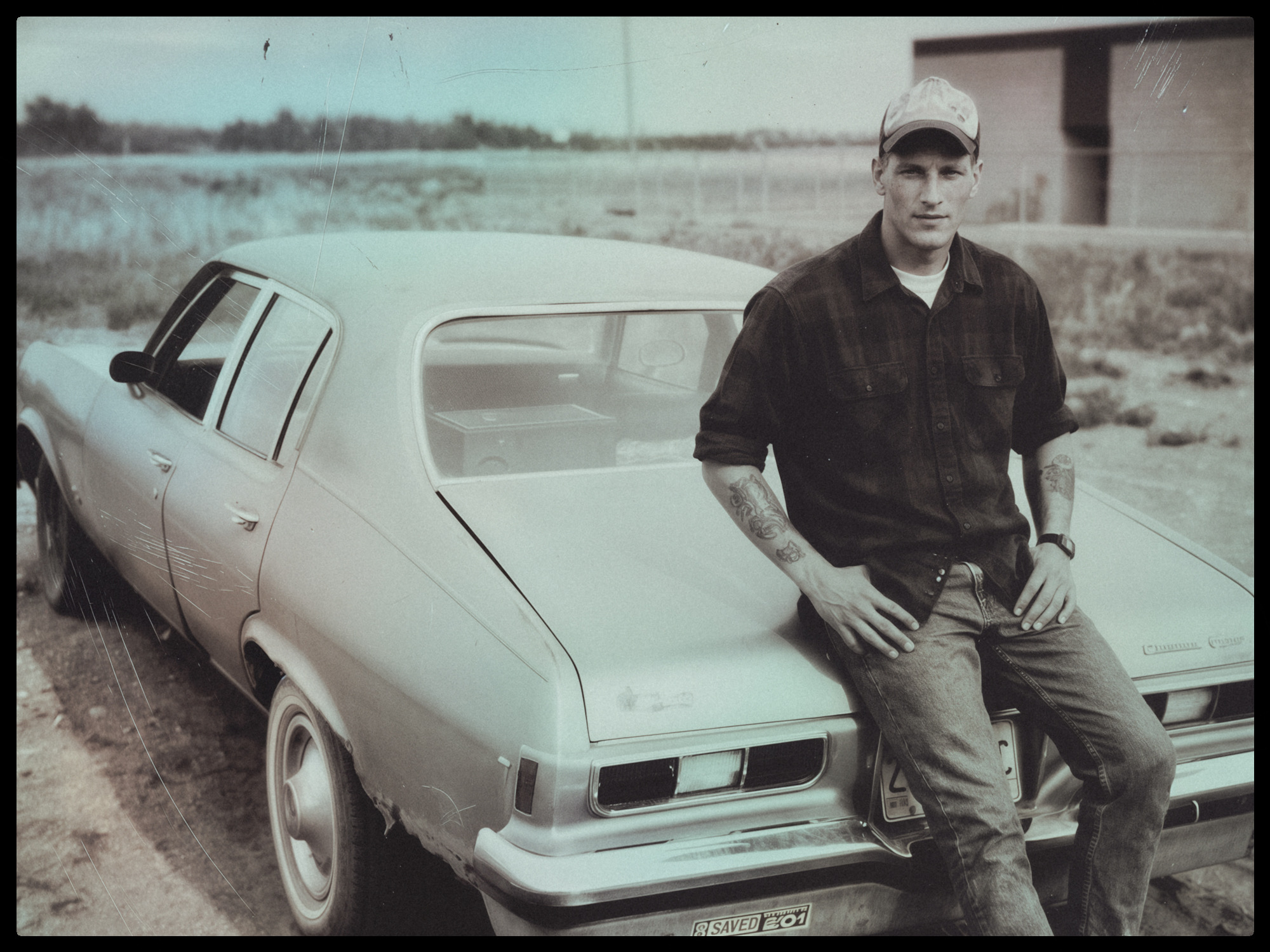
Armin Raso began working professionally as a photographer in 1997. The early work was classical in its means and black-and-white photography, portraiture and social documentary provided the vocabulary. Influences from Diane Arbus, Robert Frank and Martin Parr can be recognised in these early pictures, yet the camera increasingly became a means of pursuing Raso’s own fascination with human character, social roles and the peculiar details through which a life becomes visible. He began referring to aspects of this approach as the journalistic portrait — portraiture informed by documentary encounter rather than by the controlled conventions of the studio. This approach repeatedly drew him towards people whose biographies carried particular social or cultural histories.
In 2001 he began photographing retired and invalid veterans of the French Foreign Legion in southern France, initiating the long-term book project Ancien légionnaire, which he returned to in 2022 as Puyloubier Revisited. The ongoing work is both a homage to the men of the Legion and a biographical marker within Raso’s own life, having himself entered the Legion as a very young man.
Fascinations with eccentric figures entered the work alongside ordinary encounters and gradually formed a personal iconography around scarecrows, clowns, drag queens and marginalised outsiders more broadly. Raso’s work increasingly circled around masks, disguise, body language, projected identity and the unstable territory between the fictitious and the real. Photography became a form of close observation, placing him in the position of an ethnographer of the hidden: attentive to the small gestures, rituals and contradictions through which life sometimes acquires its visible form.
In 2004, a visit to the Freie Kunstschule Hamburg, associated with Joseph Beuys’ FIU, proved consequential. Beuys’s expanded understanding of artistic practice offered Raso a vocabulary for impulses already extending beyond the photographic print: artistic action as material, biography as an intrinsic part of the work, and the artist as mediator between experience and form. Following his move to Ireland in 2005, this expanded practice became increasingly visible through performance, poetry and cultural research. The Barrel Organ Revival brought the mechanical street organ into contemporary Irish public space and initiated further research into itinerant music, storytellers and oral traditions, such as the Gaelic «portaireacht», known as lilting or mouth music. The project already contained a tendency that would recur throughout Raso’s work: inherited forms could be removed from nostalgia as mere retrospection and made present again through artistic re-contextualisation.
Raso came to understand the artist as someone moving between lived experience and symbolic form, between the visible and what has not yet found expression. The figure of the artist-shaman became relevant here not as an identity claim, but as an artistic function — a way of describing a practice capable of entering charged situations, carrying experience across thresholds and returning it through image, gesture, sound or narrative, while moving between intimate and collective experience.
In the years that followed, the artistic research moved increasingly into ritual and transpersonal forms of inquiry — developments that did not replace the documentary foundation but widened the field around it. Rather than developing through a succession of neatly separated projects, the work accumulated autobiographically. Earlier motifs disappeared and returned years later under altered circumstances. Photography generated performance; performance produced research; research returned to the image. This is the continuity Raso describes as his Werkprozess — the evolution of practice through artistic endeavour.
Armin Raso has exhibited in Germany, Switzerland, Ireland and Northern Ireland, with work published internationally in newspapers and magazines. Professional and institutional references include the International Arts Center in Tucson, University of Arizona, Freie Kunstschule Hamburg FIU, Fermanagh District Council’s Art of Regeneration Programme, Arts Council of Northern Ireland, Deutsches Literaturarchiv and Zurich Art Weekend. He is an accredited member of impressum – The Swiss Journalists.
FEATURED PHOTOS IN:
SELECTED EDITORIAL CLIENTS: